






2026 Coeur d’Alene Art Auction / Lot 108107 / 379 • View Catalog •
 Prev Lot
•
Next Lot
Prev Lot
•
Next Lot 
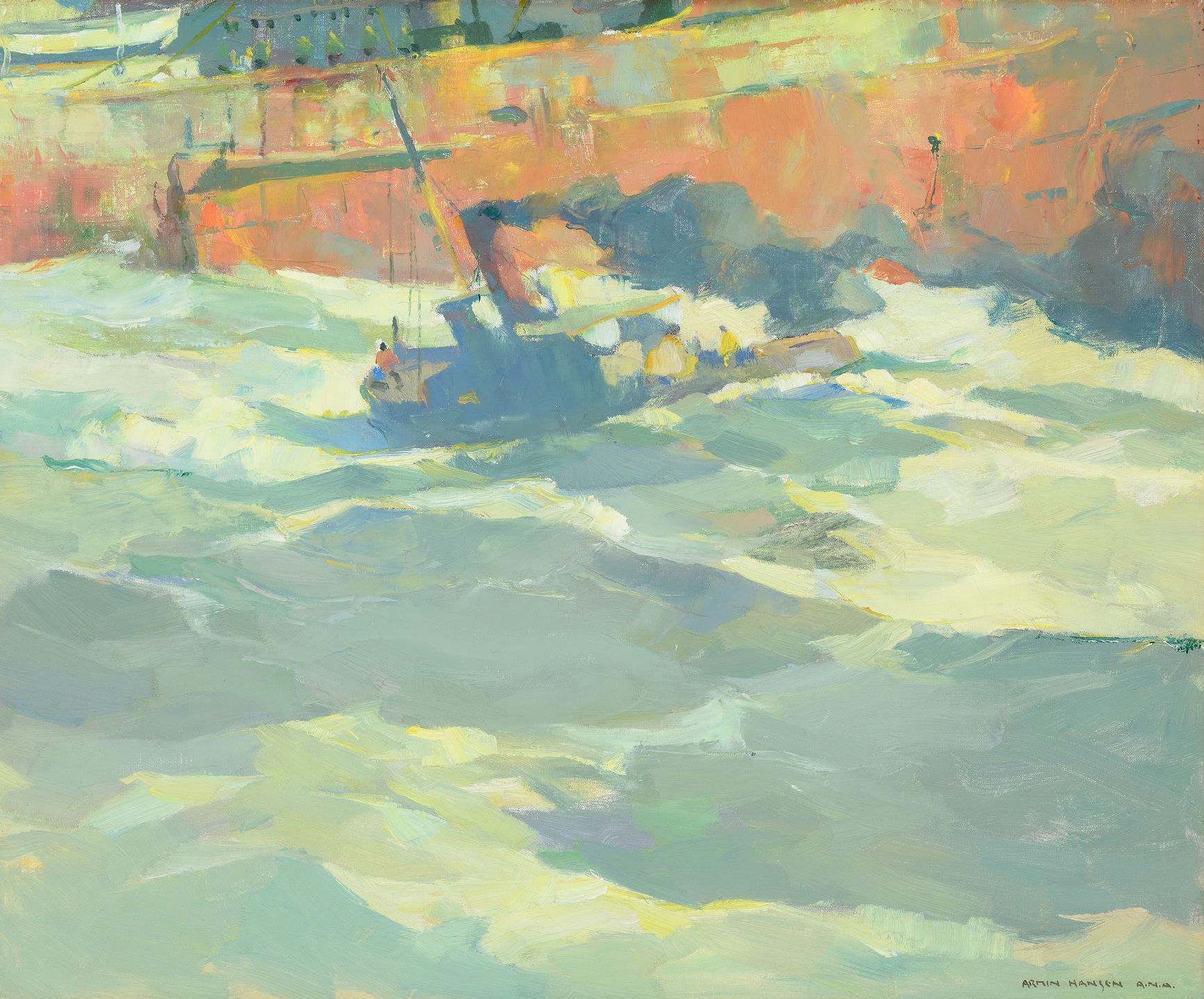


As described by arts writer Gussie Fauntleroy, “When Armin Hansen walked into a room, his friends said it was as if a gust of Pacific salt air blew in with him. He was a big man, tall and sturdy, the kind of man who looked like he could hold his own in a wave-tossed fishing boat on a stormy sea. He looked that way because he could, and had, endured all kinds of weather while crewing on fishing vessels off the California coast and on North Sea trawlers. That experience – and the deep respect and love he had for both the ocean and the men who worked upon it – found its way into his brushstrokes and paint, transforming raw physicality and labor into something enduring and beautiful.
“Hansen’s own relationship with the ocean began early. Born in San Francisco in 1886, he moved with his family to Alameda Island in San Francisco Bay at age 5. As a boy he often sailed the nearby estuaries, and on one such occasion when he was about 11, his small boat became mired in mud. As he sat waiting for the tide to return, he conceived his first marine drawing, creating it when he went home. Art instruction started early as well, first informally with his father, Herman Wendelborg Hansen, a noted painter of Western frontier life. In 1901 the younger Hansen began taking classes at San Francisco’s Mark Institute of Art, where he pursued formal training with Northern California painters, including prominent Tonalist Arthur Frank Mathews, until the earthquake of April 1906.
“But the vigorous, powerful style for which Hansen eventually became known, and which accorded well with the blustery nature of his chosen subject, developed after he traveled to Europe in 1906. For two years he studied in Stuttgart with Carlos Grethe, who painted scenes of fishermen. Both the subject and the broad, darkly intense swatches of paint in Grethe’s canvases profoundly influenced Hansen, although the California painter later shifted to a much brighter palette. Hansen visited art museums in Paris and Amsterdam, and then traveled to the Belgian coast and signed on to the crew of a North Sea trawler.
“For four years he immersed himself in maritime culture, drawing and painting that world during off-duty hours.
“On his return to San Francisco in 1912, he brought with him almost 100 new canvases.
“Soon Hansen fell in love with Monterey, whose growing salmon and sardine industry was quickly transitioning to more modern fishing and canning methods. Scores of immigrants were employed on the boats and in the canneries, and Hansen knew and portrayed many of them, especially those of Sicilian and Portuguese descent. Along with the piers, bustling harbor scenes and colorful fishing fleets, he painted them in a manner that reflected his intimate knowledge of the fisherman’s rugged life. For a few years, he kept studios in both San Francisco and Monterey. In 1918 he established year-round residency in Monterey and settled there permanently after marrying in 1922.
“It was a time of vibrant social and artistic activity for the genial painter, whose friendships spanned the socioeconomic spectrum. They ranged from immigrant fishermen such as Cosimo Aiello, whose portrait is in the exhibition, to writer John Steinbeck and poet Robinson Jeffers. Hansen was loved by his students, and well liked and admired by fellow artists in both the emerging Modernist movement and the more conservative art establishment, including the Carmel Art Association of which he was an early member. In 1920, friend and fellow painter Maynard Dixon sent him a congratulatory letter filled with superlatives. ‘Simplicity and Truth you have added – to all the color, strength, drawing and poetic feeling that you have,’ it reads in part. ‘Ye Gods! It is wonderful.’”
PROVENANCE
Private collection, Wyoming
LITERATURE
Scott A. Shields, Armin Hansen: The Artful Voyage, Pomegranate Communications, 2015, pp. 174-75, illustrated

